
Journal ·
Captain America vs Zorro: The Devil We Know and the Angel We Don't
An allegory of familiarity, fear and the courage to question what feels safe
In this article
- The proverb’s uncomfortable substitution
- Captain America: the reassurance of a recognisable shield
- Zorro: why the possible angel wears the face of an outlaw
- Two witnesses, two very different devils
- The second mask: what we think we know
- When caution becomes captivity
- A choice beyond the devil and the angel
- The allegory’s final turn
- Sources and further reading
Imagine two figures arriving at a town in trouble.
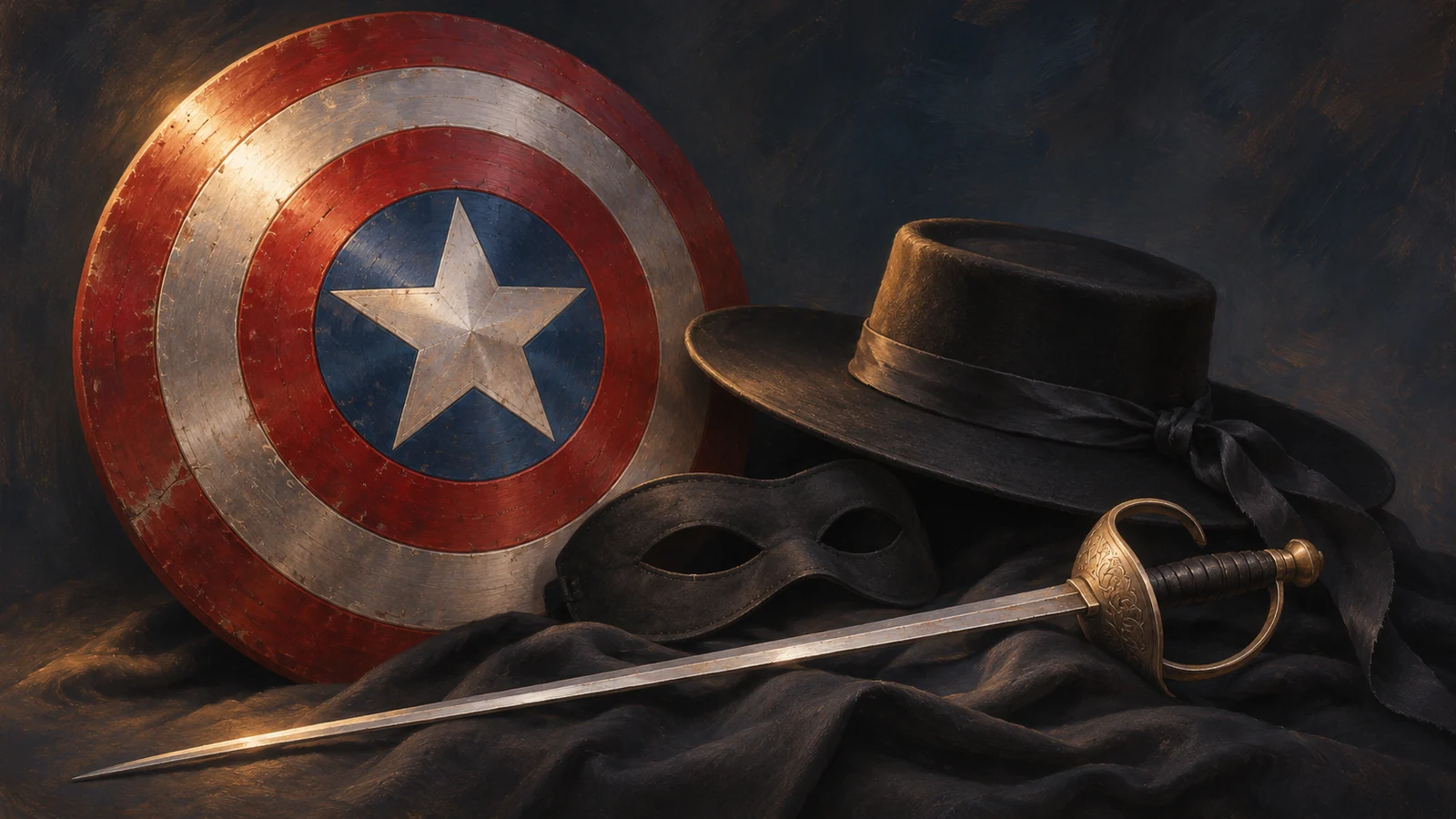
One carries a shield bearing a recognisable star. His colours announce a cause; his uniform appears to tell us who he is. The other arrives at night, dressed in black, his face hidden behind a mask. He leaves behind a single letter: Z.
Whom would the townspeople trust?
It is tempting to answer before either man has acted. The shield looks like protection. The mask looks like concealment. One figure appears familiar, accountable and respectable; the other seems mysterious, possibly dangerous, perhaps even criminal.
Yet readers know Captain America and Zorro as heroes. If we could observe their conduct rather than their costumes, that first impression would tell us remarkably little about their character.
This is where the comparison becomes an allegory for a saying that deserves more scrutiny than it usually receives:
“The devil I know is better than the angel I don’t know.”
Why would we choose a known devil over an unknown angel? Is this an expression of wisdom, or the point at which our fear of uncertainty begins to masquerade as wisdom?
The proverb’s uncomfortable substitution
The more familiar saying is “Better the devil you know than the devil you don’t.” Its logic is cautious: if both alternatives may be harmful, the harm we understand can seem easier to manage than the harm we cannot predict.
But change the second devil to an angel, and the whole proposition shifts.
Now we are not merely comparing two threats. We are considering whether familiarity can make something we recognise as bad appear preferable to something potentially good. The saying stops being a simple warning about uncertainty and becomes an examination of our relationship with fear.
There is an important qualification. If we truly knew that the stranger was an angel, choosing the devil would make little moral sense. But an unknown angel is not yet a verified angel to the person making the choice. We may have heard promises, noticed signs of kindness or hoped for rescue; we have not yet seen enough to be certain.
That ambiguity is the heart of the problem. Knowing someone exists, knowing what they routinely do and knowing whether they are good are three different kinds of knowledge.
Familiarity can supply the first two while leaving the third painfully unresolved.
Captain America: the reassurance of a recognisable shield
Captain America offers a compelling image of public trust. His shield, star and national colours make him immediately legible as a defender. He does not need to introduce himself each time he enters the frame. The emblem arrives before the man.
There is a reason this matters. Symbols reduce uncertainty. A uniform can tell us where someone claims to belong, whose ideals they claim to serve and what sort of behaviour we might expect. When a community has witnessed someone repeatedly act with courage and restraint, recognition can become deserved trust.
But recognition is not the same thing as verification.
A familiar uniform may reassure us even before we have examined the conduct of the person wearing it. An institution can borrow credibility from its history. A leader can borrow it from a title. A relationship can borrow it from years of shared experience, even when those years have supplied abundant evidence of harm.
Captain America makes this tension especially interesting because Steve Rogers is not simply a servant of official power. In the Nomad storyline, disillusionment with government corruption leads him to lay aside his Captain America identity rather than abandon his conscience. Marvel’s collected edition preserves that turning point.
The familiar shield is therefore not the final measure of the man’s goodness. His willingness to question what the shield might be taken to endorse is part of the reason he deserves admiration.
Captain America teaches a paradox: a trustworthy person must sometimes become unfamiliar to remain trustworthy.
What happens when the hero we recognise refuses the role we expect him to play? Do we trust the character we have witnessed, or do we begin to doubt him because he no longer behaves like our preferred image?
Zorro: why the possible angel wears the face of an outlaw
Zorro approaches the same problem from the opposite direction.
Created by Johnston McCulley in 1919, Zorro operates in a fictionalised Spanish California where those exercising authority can abuse it. His mask conceals Don Diego, a wealthy man whose apparently unthreatening public behaviour disguises his capabilities. The character’s history and McCulley’s original tale establish the importance of that double life.
To the officials he challenges, the masked swordsman is dangerous precisely because his identity cannot be controlled. To people he protects, the same uncertainty may be a source of hope.
His outward appearance offers little conventional reassurance. Black clothes, a hidden face, a sword and a reputation as an outlaw might ordinarily trigger suspicion. Yet the qualities that make him alarming to those in power can make him valuable to those suffering under that power.
This is not an invitation to trust anyone who appears mysterious or rebellious. Masks can protect predators as easily as protectors. It is an invitation to notice that the person labelled a devil may have been labelled by the very people whose behaviour needs examining.
Who gets to name the devil? Who gets to certify the angel?
A citizen who has known only an unjust governor might call that governor predictable. The masked stranger is not predictable. But predictability does not cleanse the governor’s cruelty; nor does mystery erase the stranger’s good deeds.
Zorro forces us to separate two questions we often merge: Do I know who you are? and Do I know what you stand for?
Two witnesses, two very different devils
Our imaginary town now presents a difficulty. Imagine the shield-bearing hero is welcomed by its officials while Zorro is declared an enemy. From the viewpoint of established authority, the man in black may look like the devil nobody knows.
But consider the town through the eyes of someone repeatedly mistreated by those officials.
For that person, the authorities are not an uncertain danger. They are the devil already known: familiar faces, familiar threats, familiar excuses. The masked outsider may be unproven, but his arrival introduces a possibility that the current order has denied them.
The same event produces two contrasting judgements because the witnesses occupy different positions.
| Question | The comfortable observer | The person bearing the harm |
|---|---|---|
| What feels safe? | The order they recognise | Relief from the order they know |
| What feels dangerous? | An unfamiliar challenger | Continuing a familiar injustice |
| What must be proved? | That change is necessary | That hope is not another deception |
| What can be overlooked? | Suffering outside their experience | The real risks of trusting a stranger |
Neither observer is automatically right. Someone who suffers can still be deceived by a false rescuer. Someone who benefits from stability can still recognise an injustice and help correct it.
The point is that our sense of safety may describe our position within a system more accurately than it describes the system’s morality.
The known devil may be tolerable to one person because someone else pays the price of knowing him.
The second mask: what we think we know
Zorro wears an obvious mask. Captain America wears a recognisable uniform. The more subtle possibility is that each offers a kind of concealment.
The mask openly admits that some information is withheld. It asks us to judge what we can observe without possessing the full identity of the actor.
The uniform offers the opposite temptation: because it supplies a recognisable identity, we may feel that there is nothing important left to discover.
Yet the greatest misunderstanding is not always caused by the person hiding a face. Sometimes it is caused by the observer assuming that a familiar face cannot hide anything.
Don Diego’s civilian persona demonstrates this directly. He is known socially while his competence and convictions remain concealed. Steve Rogers, conversely, may be publicly celebrated while his moral independence is misunderstood by people who expect obedience from a patriotic symbol.
In both cases, being known and being understood are not interchangeable.
Our perception identifies the visible signs. Our perspective decides what those signs mean to us. Our judgement must then ask whether the interpretation survives contact with evidence.
A mask is not proof of wickedness. A star is not proof of virtue. The test is what the bearer does when protecting others becomes costly.
When caution becomes captivity
There are reasonable grounds for preferring a known risk to an unknown alternative. We may understand the existing danger, have safeguards against it or lack the resources to endure a failed change. Caution is not necessarily cowardice.
But caution changes character when the familiar harm is no longer honestly examined.
A person may remain in an unsatisfying situation because its disappointments follow a schedule. A community may tolerate an abusive authority because it knows how to negotiate with that authority. An organisation may defend a failing process because everyone understands its failures, while improvement requires unfamiliar effort.
Such choices can be influenced by what psychologists call status quo bias and ambiguity aversion: a pull towards the existing arrangement and a reluctance to accept outcomes whose probabilities are difficult to assess. These are useful descriptions of tendencies, not diagnoses of anyone who makes a cautious decision.
The danger is that familiarity can gradually acquire the status of a moral argument.
“We know what to expect” becomes “This is safer.”
“This is safer” becomes “This is better.”
And “This is better” can become an excuse never to ask better for whom?
In that progression, the devil wins without having to persuade anyone that he is good. He need only persuade them that everything beyond him is unknowable.
A choice beyond the devil and the angel
Captain America and Zorro are helpful precisely because neither can be reduced to an easy visual rule. The publicly recognised hero can resist the institution associated with his colours. The masked outlaw can act from a sense of justice, while using deception and privilege in ways that still deserve scrutiny.
Neither hero gives us permission to surrender judgement.
If a stranger promises rescue, we should examine conduct rather than accept the promise. If a familiar institution demands loyalty, we should examine its conduct rather than accept its history as proof. We should ask who is helped, who is harmed, what can be independently established and what accountability exists if our judgement proves wrong.
The wise alternative to blind loyalty is not blind faith in the unknown. It is discernment: the willingness to test the familiar without romanticising the stranger.
This brings the proverb into a different light. Perhaps it is not fundamentally about choosing between two people. Perhaps it is about the uncomfortable distance between certainty and truth.
We can be certain about someone’s habits and mistaken about their goodness. We can be uncertain about someone’s identity and still recognise evidence of courage, compassion or restraint.
The label devil or angel should follow what we learn, not determine what we are willing to learn.
The allegory’s final turn
At first glance, Captain America appears to be the figure we know, while Zorro represents the figure we do not. That is the convenient arrangement of the allegory—not a moral verdict on either man.
Look more closely, and the arrangement begins to reverse.
Steve Rogers becomes unfamiliar when he refuses to let an institution define his conscience. Don Diego becomes familiar when his actions reveal a consistent purpose despite his disguise. One asks us to look beyond a respected symbol; the other asks us to look beyond a suspicious appearance.
Both undermine the same mistake: allowing the comfort of recognition to substitute for the work of judgement.
The saying “the devil I know is better than the angel I don’t know” may describe a real fear. It does not, by itself, establish a wise choice.
The devil does not become an angel because we know his name. And an angel does not become a devil because we have yet to see his face.
Perhaps the greater wisdom is neither to cling to what we know nor to chase what we imagine, but to remain brave enough to discover what is true.
If familiarity is the reason we trust someone, what happens when the evidence finally asks us not to?
Sources and further reading
The characters and episodes referenced here are drawn from their published stories; the comparison with the proverb is an interpretive allegory, not an official meaning assigned to either hero.
- Marvel: Captain America Comics #1, for the character’s introduction and original symbolism.
- Marvel: Captain America and the Falcon: Nomad, for Steve Rogers’ break with an institution he no longer trusts.
- Zorro Productions: official character history, for the masked hero’s origins.
- Johnston McCulley: The Curse of Capistrano, chapter 39, for Don Diego’s account of his double life.